
Info Posts, natural firelighters, Wood Fuel
The Science of Efficient Wood Burning
19
Aug
Aug
More heat. Less smoke. Clearer glass. With winter coming, here’s how to run your stove like a pro—by understanding the combustion stages, choosing the right fuel, using air controls effectively, and warming the flue the right way. When you’re ready, book a HETAS survey/installation and stock up on Hot Box ® Firestarter for an effortlessly clean start every time.
Winter rush: Installation and sweep slots fill fast from September. Secure your preferred date now.
Combustion Basics: What “Efficient” Really Means
- Stage 1 – Drying: Any remaining moisture boils off before real burning begins. Wet logs waste heat.
- Stage 2 – Pyrolysis: Heat breaks wood into gases and charcoal. Most smoke is created here if the fire is too cool.
- Stage 3 – Flaming combustion: Those gases burn as visible flame—this is where clean heat is made.
- Stage 4 – Charcoal: The final stage provides steady heat and helps the next reload ignite quickly.
Key takeaway: Keep the firebox hot and the air cleanly adjusted so gases burn in the flame—not in your chimney.
Fuel & Moisture: Dry Wood Wins Every Time
- Moisture target: Use seasoned logs at or below ~20% moisture. Store off the ground with good airflow.
- Species: Dense hardwoods (e.g., ash, beech, oak) give longer, steadier heat than softwoods.
- Log size: Split to suit your firebox; smaller splits ignite faster and help achieve clean flames after reloads.
- Never burn: Treated/painted wood, MDF/ply, or wet/freshly felled logs.
Start every fire cleanly with Hot Box ® Firestarter to minimise smoke and protect the glass and rope seals.
Air Controls & a Clean Flame
- Primary air: Feeds the base of the fire—useful on start-up and for charcoal, but too much can cool the firebox.
- Secondary/airwash: Feeds air above the fire to burn off gases and keep the glass clearer. Aim for bright, lively flames (not a dull smoulder).
- Tertiary jets (on many Ecodesign stoves): Add pre-heated air for cleaner combustion—another reason to consider an Ecodesign-ready stove.
- Avoid slumbering: Starving the fire of air for long periods increases soot and deposits.
Flue Dynamics: Warm Flue, Happy Stove
- Warm-up first: Open the air fully for the first 10–15 minutes so the flue reaches operating temperature quickly.
- Stable draw: A warm, steady flue pulls smoke through the flame zone for cleaner combustion.
- System design matters: Liner condition/size and route affect draw. If you’re unsure, book a survey.
- Sweeping: Have the chimney swept before winter for safety and performance—book a sweep.
Clean-Start Lighting Routine (No Kindling Required)
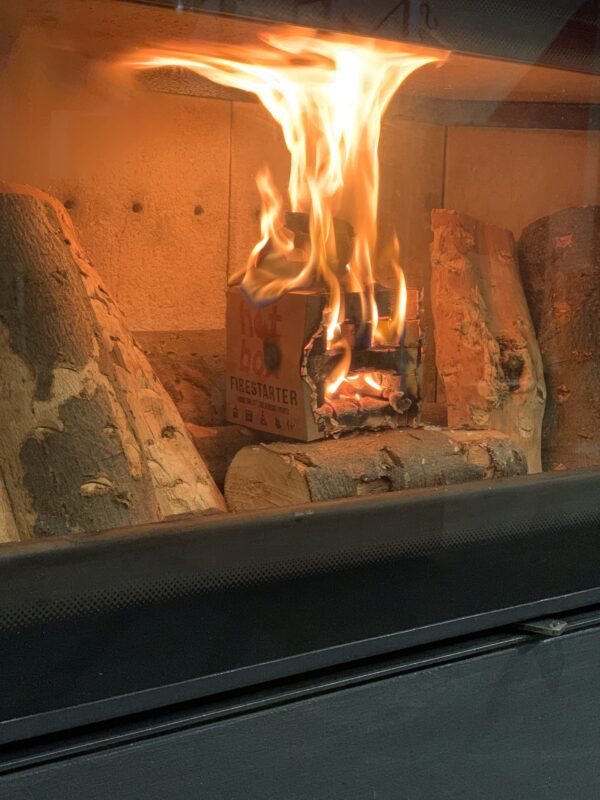
- Open all air controls fully. Place one Hot Box ® Firestarter in the centre of the firebox.
- Stack 3–4 small, dry splits around it with space for airflow (don’t pack tightly).
- Light the Firestarter and close the door fully. Let the flame build and heat the flue for 10–15 minutes.
- When flames are bright and clean, begin reducing the primary air. Maintain lively secondary flames.
- Add slightly larger splits once a healthy ember bed forms.
Result: Faster clean burn, clearer glass, and less soot formation.
Smart Reloading for Consistent Heat
- Don’t let it die: Reload when flames are still active and a good ember bed remains.
- Door technique: Open the door slightly for a second to equalise pressure, then open smoothly to reload (reduces smoke spillage).
- Size & placement: Use a couple of modest splits rather than one big log; place to encourage airflow around the fuel.
- Re-establish: Open air for a few minutes after reloading, then trim back to maintain a clean flame.
Troubleshooting (Fast Fixes)
| Issue | Likely Cause | Quick Fix |
|---|---|---|
| Blackened glass | Wet wood, low flue temperature, air controls too low | Use Firestarter, dry logs, open air fully for start/reload |
| Smoke spills when door opens | Cold flue, negative room pressure, opening door too fast | Warm on high first, crack door briefly before opening, check ventilation |
| Hard to control heat | Flattened rope seal, warped baffle, wrong fuel | Inspect/replace via stove spares; use dry hardwood |
| Low heat output | Oversized room, poor fuel, choking primary air | Smaller splits, clean flame, consider an appropriately sized stove |
FAQs
What moisture content should my logs be?
Aim for ~20% or less. Store off the ground, covered on top, open at the sides for airflow. Kiln-dried or well-seasoned hardwoods give the cleanest results.
Why does my glass keep going black?
It’s usually low temperature and/or wet fuel. Start clean with Hot Box ® Firestarter, use dry wood, and keep a lively flame for the first 10–15 minutes.
Is it okay to slumber the stove overnight?
We don’t recommend long slumbering—cool fires produce more soot and deposits. Run a clean, hot burn and let the stove cool naturally.
Do Ecodesign stoves really burn cleaner?
Yes—many feature improved air paths and tertiary jets that help burn off gases at higher efficiency. See our Ecodesign-Ready range.
Keep exploring: Stove Spare Parts – Extend the Life of Your Appliance · The Ultimate Guide to Hearths & Surrounds

 Stoves
 Bio Ethanol Fires
 Beams
Beams Fireplace Surrounds
 Hearths
 Fireside Services
 Logs For Wood Burner
 Outdoor Living
 Instant Quote
 Contact Hot Box®