
Info Posts, natural firelighters, Wood Fuel
The best wood for woodburners | What wood to burn

23
Feb
Feb

Wood Fuel
Choosing the correct wood fuel is an important part of stove ownership, make your your logs are ‘oven ready’ 🪵
The best wood for woodburners | Most polluting fuels to be banned in the home.
The best wood for woodburners, is a current debate in many media outlets.
As the popularity of wood burning stoves has increased so has their presence in the media.
Recent debates focus mainly on fuel type and quality with view to reducing harmful emissions.
This article aims to set out the best wood for use in wood burning stoves and considers how to reduce their environmental impact.
The use of good quality wood fuel in our homes is the key to a reduction in harmful emissions. Further, by using netter wood in our stoves we will get more benefit in terms of heat and the longevity of the appliance will increase.

Which wood is best for burning?
Oven ready logs are what you need for your fire. An ‘oven ready’ log will have a moisture content of less than 20%.
Further, different types of wood provide different benefits when used in a wood burning stove.
At Hot Box, we have set out the most popular wood types used in the UK and outlined their benefits and pitfalls.
Moreover, we have listed the ones at the top of the tree first……..
The top 6 wood fuels to burn in your stove
The best wood for woodburners
At Hot Box, we are frequently asked, which wood for wood burning stoves and which wood is best for burning?
Belay, we have provided some insight into different types of wood and how they will burn when used in a wood burner or wood burning stove.
- Ash: a hardwood that is considered the best for burning; it gives out a good flame
and heat, and will burn when green, however, it is never a good idea to burn green
wood in a stove. - Beech: considered a rival to ash, though not a close one. It does tend to spit out
embers far into the room, so beware using in an open fire, but ideal for a stove. - Birch: a hardwood that produces a good heat but it burns quickly. The smell is
pleasant. - Thorn: one of the best woods. It burns slowly, giving a good heat and not much
smoke. - Cherry: another hardwood that burns slowly, giving out good heat. It also gives
off a nice smell when burnt. - Oak: a hardwood, it gives out few flames but the smoke is acrid. Dry old oak is
excellent for heat, burning slowly and steadily.
Other wood for wood stoves.
Despite not having made the cut the following are still contenders if available.
- Alder: a softwood with a high water content. It gives out little heat and doesn’t
last for long. - Apple: a hardwood that burns slowly and steadily when dry, with little flame,
giving good heat. The scent is pleasant. - Cedar: a softwood that burns well when dry. Much better in a stove than in an
open fireplace. - Chestnut: this must be one of the noisiest firewoods, best in a stove. It has a
small flame and doesn’t give out much heat. Avoid if possible, or mix these logs
with a hardwood. - Douglas Fir: not much good.
- Elder: a softwood that is very smoky. It is a quick burner, without much heat.
- Hazel: good.
- Holly: good, best seasoned for a year, like all logs for woodburning stoves.
- Hornbeam: almost as good as beech.
- Larch: a softwood that gives a crackly sound. It gives out a scent, and is quite
good for heat. - Laurel: gives a good bright flame.
- Maple: another hardwood that is good for burning.
- Pear: a hardwood giving good heat scent.
- Plum: hardwood that gives heat and scent.
- Rhododendron: the thick old stems, being very tough, burn well.
- Robinia (Acacia): burns slowly, with good heat, but with acrid smoke, so use in a
woodburner as opposed to an open fire. - Sycamore: burns with a good flame, with moderate heat.
- Walnut: hardwood that gives out very good heat and a beautiful aroma.
- Yew: burns slowly, with fierce heat, and the scent is pleasant
The wood the bad and the ugly….
At Hot Box ®, we would not advocate the use of the following wood for use as fuel.
- Willow: Poor as it has a high water content. It must be dry to use, and then it
burns slowly, with little flame and sparks. - Spruce: a softwood that burns very quickly and gives out a lot of sparks – one to
avoid if possible. - Poplar: one to avoid.
- Pine: is a softwood that burns with a good flame, but it is apt to spit. The resinous
Weymouth pine has a lovely scent and an interesting blue flame. High resin contents are not good for flue liners. - Plane: burns fairly well, but is prone to throwing sparks.
- Laburnum: one to avoid because it is a poisonous tree, giving acrid smoke,
tainting food and best never used. However it can be used by wood turners as it
has a beautiful pattern. - Lime: not a favourite as it has a poor flame.
- Elm: this is commonly offered for sale due to Dutch Elm disease. To burn well it
needs to be kept for two years. Even then it will smoke, a very variable fuel.
Seasoned wood V Kiln dried wood
At Hot Box our view is this. If you have the ability to buy in advance, store and properly season the wood for your stove then your fuel will be good. However, we recommend that you get a weeks worth into the house in advance of burning to allow further drying. Moreover, seasoned wood fuel is cheaper than buying kiln dried.
However, kiln dried wood offers user convenience and a consistent product. Further, it could be argued that despite the price hike you will get more heat for your buck. Should space be at a premium at home, we would highly recommend considering the use of kiln dried logs versus seasoned or seasoning your own.
In addition, due to the process, kiln dried logs tend to come neatly stacked on pallets and when stored undercover are a very convenient way to fire your wood burner.
Lighting your wood burner
Watch Hot Box ® Firestarter 🔥
When it comes to emissions, the process of effectively lighting your wood burning stove is key.
Most harmful emissions form stoves, swell as from the use of wet or unseated wood fuel come during lighting and when the fire is beginning to die down.
At Hot Box, we advocate the use of natural solutions to light wood stoves coupled with good dry kindling.
Remember, build up your fire slowly and get some heat into the chamber and flue before adding larger logs.
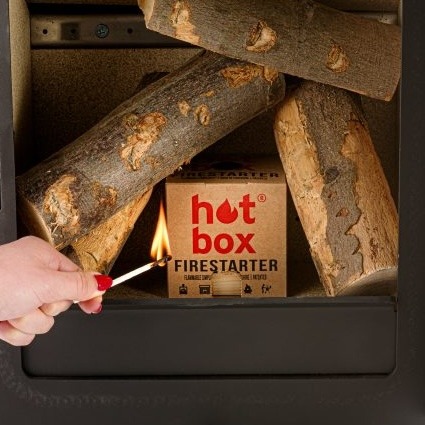
When considering fire lighting products few come close to the convenience of our own, Hot Box Firestarter is a patented combustion aid that replaces both firelighters and kindling to get you burning.
Couple this with our advice on the best wood for woodburners and you are guaranteed to get the best from your wood stove.
The best wood for woodburners
Reducing emissions one log at a time….
When we consider how to reduce emissions from our stoves in line with government regulation the advice can be summarised as follows:
- Eco design ready stoves, a new initiative that will be fully operational by 2022. The initiative aims to reduce emissions at source by making stove manufacturers facilitate changes to appliances. Such changes will result in more efficient and cleaner stoves.
- Proper and compliant stove installation.The way in which your wood-burner is fitted can have an impact on how it performs. When considering installing a stove always engage a bona fide company registered with HETAS.
- When lighting your wood burner or stove consider the principals of efficient combustion. Build up the fire using kindling and smaller logs before introducing larger fuels.
- Source your fuel carefully, avoid p[petrol stations, supermarkets and DIY outlets unless they can offer fuel that is Woodsure approved.
- Servicing and maintenance. As with any household appliance you should regularly have your stove serviced to ensure it is in good working order. At Hot Box, we advise that you do this biannually. .
In conclusion, the reduction in PM2.5, small particles of air pollution, can be reduced by bringing about changes in what we use to heat our homes. Hot Box Stoves believe that by regulating the sources of wood fuel and managing re-forestation for the same purpose, wood and the stoves we use it in, will be of benefit to the future environment.
The best wood for woodburners and the means of proper ignition are at the forefront of our business, firelighter and fuel packages coming to shelves near you later this year!
Further, perhaps we should also consider the following questions:
-
Why burn wood?
-
Is wood burning carbon neutral?
-
The best wood for woodburners?
Three extremely valid questions, especially in an age where we strive for convenience. It could be argued that wood burning stoves and the process of using them is far from convenient.
However, there are an array of benefits to be gained from burning wood as a fuel and heat source. Therefore, we have complied our top 5….
- Wood is renewable, as such we are not depleting global resources by using it as a fuel so long as proactive replanting is considered.
- Burning wood is arguably carbon neutral. When wood is burnt it releases carbon dioxide which is absorbed by growing trees. It is important to consider transport in this cycle and aim to offset other carbon producing activities.
- Further, Wood fuel can provide heat even if your regular gas or electricity supply is interrupted
- The infrared heat provided by burning wood is good for us, it can increase blood circulation, enhance the immune system and reduce joint pain and inflammation.
- The use of wood as a fuel, especially if locally sourced, stacked and correctly seasoned can save us money on our heating bills. For the ultimate in economic benefits its worth considering a boiler stove so that you get hot water as well as heat from burning wood.
Prepare for winter | The best wood for woodburners
Owning a wood burning stove, optionally, requires a degree of preparation for each burn season.
Importantly, to get the most out of your wood stove you should consider sourcing and stacking your wood for winter during the summer months.
This preparation can be an enjoyable process and will offer a more cost effective solution than buying kiln dried or seasoned logs just in time.
Further, the process of splitting, stacking and storing firewood has wider health benefits. The physical exertion required to create a stack of firewood can be significant.
Usually, when sourcing wood fuel from a supplier, you may need to embark on some further splitting and drying to ensure your firewood is ‘oven ready’.
If space is available, it is often a good idea to source enough fuel in one go to see you through the entire winter or ‘burn season’.
On average, with moderate use during the autumn and winter months, stove users build around 80 fires and use circa 2m3 of logs.
However, if you are using your stove for more than space heating, heating water for instance, or if you have multiple wood stoves in your house, then you need to consider carefully the quantity of fuel required.
Moreover, one of the criteria under the HETAS competent persons scheme, is that a stove user should have the available space to store at least 1m3 of firewood for use in a woodburner.
Processing Firewood
Processing firewood is the process of preparing wood for use as a heat source. This can include cutting, splitting, and seasoning the wood. Properly processing firewood is essential for ensuring that the wood burns efficiently and safely. In this article, we will discuss the various steps involved in processing firewood and the importance of each step.
The first step in processing firewood is cutting the wood to the appropriate length. This typically involves cutting the logs into 16-18 inch lengths, which are the most efficient size for burning in a fireplace or wood stove. It is also important to remove any branches or debris from the logs, as these can impede the burning process and create creosote buildup in the chimney.
The next step is splitting the logs. This is done to increase the surface area of the wood, which allows it to dry out more quickly and also allows for a more efficient burn. Splitting the logs also makes it easier to fit them into the fireplace or wood stove. There are several different tools that can be used for splitting wood, including a maul, an axe, and a log splitter.
Do I actually need Kindling?
Lighting a fire without kindling is entirely possible.
However, you will need to be pretty skilled and generate significant heat to do this.
Arguably, kindling is needed to generate the heat required for larger logs or wood fuel to ignite.
We hope however, through increased use of Hot Box ® Firestarter, that kindling will become a thing of the past.
Firewood processing
Seasoning, Splitting, Stacking, Firewood
Firewood can keep you warm more than once, the process of seasoning, splitting and stacking firewood can be quite satisfying in preparation for the winter season. When its cold, there is no better feeling than having all your wood fuel prepared ready to enjoy the fire.
Seasoning and drying
After the wood has been split, it needs to be seasoned or dried. This process can take anywhere from six months to a year, depending on the type of wood and the weather conditions. Seasoning wood helps to remove the moisture from the wood, which makes it burn more efficiently and also reduces the amount of smoke and creosote produced. Properly seasoned wood will have a moisture content of 20% or less.
Finally, the firewood should be stored in a dry, well-ventilated area. This will help to prevent rot and decay, and also keep the wood in good condition for burning. It’s also important to keep the woodpile elevated off the ground, using a platform or pallet, to allow air to circulate around the wood.
In conclusion, processing firewood is an essential task for anyone who uses wood as a heat source. Properly processing the wood by cutting, splitting and seasoning, and storing it properly, will ensure that the wood burns efficiently and safely. It’s also important to use the appropriate tools and techniques for each step, to make the process more manageable and efficient. By taking the time to process your firewood, you can enjoy a warm, cozy fire all winter long.
Splitting and storing wood | The tools for the job
As with all processes, splitting firewood requires certain tools. Having the right tools for the job can make life much easier.
For example, source an appropriate chopping block, a large tree stump is great.
Sourcing a good quality splitting axe or ‘maul’ is important. Gransfors Bruks offer some quality examples.
if buying seasoned and partially split logs, a small splitting axe will make light work of reducing your logs down to size.
Reduce waste, consider chopping smaller logs into kindling using a hatchet. The Estwing Sportsmans hatchet is a perfect tool for smaller scale wood butchery.
Storage is important, a good log store is crucial. Air flow is key when it comes to the drying process of firewood.
A covered roof and an open front makes for a good log store, good airflow around your stack will promote further drying of seasoned firewood.
If you are buying and splitting unseasoned wood, the rule is this. A year outside exposed to the elements in a proper stack. A further year, stacked undercover to properly season the timber.
For further reading on this subject, there are two books which offer invaluable insight. Norwegian Wood and The Wood Fire Handbook.
Stacking Firewood
Stacking firewood is an essential task for anyone who uses wood as a heat source. Not only does it keep the wood dry and ready to burn, but it also helps to prevent pests and insects from infesting the woodpile. In this article, we will discuss the proper methods for stacking firewood, including the types of wood to use, the best location for the woodpile, and the most efficient stacking techniques.
The first step in stacking firewood is to choose the right type of wood. Hardwoods, such as oak, hickory, and maple, are the best choice for firewood because they burn hotter and longer than softwoods. Softwoods, such as pine and spruce, are also suitable for firewood, but they should be used in conjunction with hardwoods for optimal results.
The location of the woodpile is also important. The woodpile should be placed in a well-ventilated area that is protected from the elements, such as a shed or a covered patio. Avoid stacking wood against the side of a house or building, as this can lead to pests and insects infesting the woodpile.
Stacking methods and techniques
When it comes to stacking the wood, there are several different techniques that can be used. The most common technique is the “cordwood” method, which involves stacking the wood in a neat and orderly manner, with each piece of wood placed perpendicular to the one below it. This technique provides excellent ventilation and allows the wood to dry out quickly. Another technique is the “log cabin” method, which involves stacking the wood in a log cabin-like fashion, with the ends of each piece of wood facing out. This technique is more visually appealing than the cordwood method but can be less efficient in drying out the wood.
In addition to these stacking techniques, it is also important to keep the woodpile elevated off the ground. This can be done by placing a layer of gravel or bricks underneath the woodpile, or by using a platform or pallet. Elevating the woodpile will help to keep the wood dry and prevent rot and decay.
In conclusion, stacking firewood is an essential task for anyone who uses wood as a heat source. Properly stacking firewood will help to keep the wood dry and ready to burn, and will also help to prevent pests and insects from infesting the woodpile. By choosing the right type of wood, selecting the best location for the woodpile, and using efficient stacking techniques, you can ensure that your woodpile is always in good condition.
Interesting facts about wood and kindling…
To continue our featured article in relation to wood, we thought that the addition of some interesting facts might light your fire.
interestingly, the use of tinder, kindling and wood is an age old concern.
Further, when considering wood and kindling, there are some scientific elements which may help a users understanding.
- Making fires with tinder, kindling and wood dates back to Neanderthal man.
- There are a number of ways to make fire. Namely, natural occurrences, friction, percussion, lighters, solar, chemical and electrical. Thereafter, both kindling or fuel are required to sustain the fire and ternate heat. Further, there is now Hot Box ® Firestarter which embodies the principals of the fire triangle, Heat | Oxygen | Fuel.
- Moreover, fires start from an increase in temperature to the point where combustion occurs. All materials, commonly used for tinder and kindling, have an auto-ignition point. Interestingly, wood kindling is between 300 and 482 ℃. Further, the video below outlines how Hot Box ® Firestarter heats a wood stove to the point where wood logs auto ignite.

 Stoves
 Bio Ethanol Fires
 Beams
Beams Fireplace Surrounds
 Hearths
 Fireside Services
 Logs For Wood Burner
 Outdoor Living
 Instant Quote
 Contact Hot Box®
Pingback: Kindling v Hot Box Firestarter | Hot Box Firestarter
Pingback: The best way to light a fire | What fuel to burn | Hot Box Firestarter
Pingback: 5 Ingenious ways to use a Hot Box Firestarter | The Ultimate Fire Lighter
Pingback: Kindling | The key to making the perfect fire? | Hot Box Firestarter
Pingback: The future of firelighting | Wet wood banned | Hot Box Firestarter
Pingback: Stuv Wood Burning Stoves | Available from Hot Box ® Stoves 🪵🔥